
In June 2026, Michigan Medicine reported the first permanent wireless implantation of Paradromics' Connexus brain–computer interface (BCI). Elsewhere in neurotechnology, researchers can log into FinalSpark's platform to run experiments with living neuronal cultures. A report on this field has to make room for both.
Between those examples sit EEG (electroencephalography) systems, prosthetic hands, stimulation devices and imaging software. Their users range from laboratory researchers to clinicians and people using a device at home. Grouping them by what they do makes the industry easier to understand.
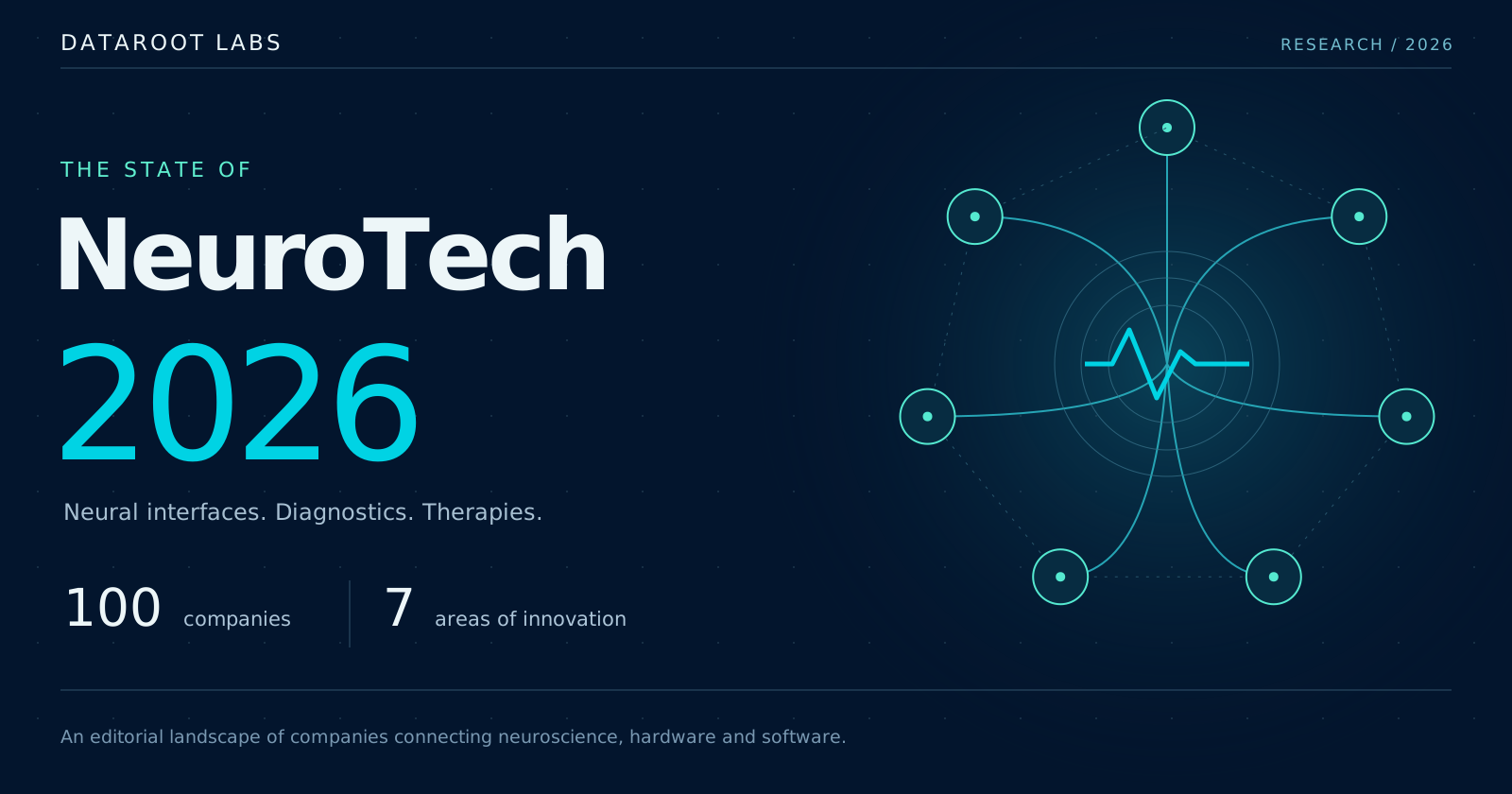
For this edition, we revisited the companies in our earlier NeuroTech report, followed changes in products and ownership, and looked for additional developers to include. The result is a guide to 100 companies across seven areas of neurotechnology.
How we put this edition together
The selection includes early-stage developers, established private businesses and companies that have reached public markets. We grouped them by their principal technology or application so readers can compare related work.
We reviewed company materials, scientific papers, clinical trial registries, institutional announcements and regulatory records through 6 October 2026. Sources accompany each profile. Dates and regulatory references apply to the particular product or programme described.
A research platform, a device in a clinical study and a product already in use occupy different places in this report. The profiles identify those stages where they are relevant to understanding the work.
Where the interface meets the nervous system
Electrode placement is a useful starting point for understanding a brain–computer interface. Developers record from within neural tissue, from the brain's surface, from inside a blood vessel or from outside the body. Each choice affects the hardware and the procedure needed to put it to use.
Paradromics' Connexus programme targets assistive communication. Synchron takes an endovascular route, recording neural activity through an implant in a blood vessel; its INTENT programme is registered as an early-feasibility study.
Precision Neuroscience is working with high-density electrodes on the cortical surface. In March 2025, its Layer 7-T received FDA clearance for temporary recording, monitoring and stimulation lasting less than 30 days. That time limit is part of the clearance.
A March 2026 Chinese regulatory announcement covered a different application: Neuracle's epidural interface and pneumatic glove for hand-function compensation in a defined group of adults with spinal cord injury. Here, the interface links neural recording and decoding to an assistive device.
Other approaches use stimulation to act on neural activity. Motif's RESONATE programme studies an implantable system; ReVision is developing a cortical visual prosthesis that translates camera input into stimulation patterns. Nudge is investigating low-intensity ultrasound in feasibility studies.
Stimulation beyond the brain
A large part of neurotechnology works through peripheral nerves. The applications in this report include urinary symptoms, migraine, tremor, pain and inflammatory conditions.
Consider urinary symptoms. Neuspera uses implanted sacral neuromodulation, BlueWind targets the tibial nerve with an implant, and Avation offers a wearable stimulation system. The clinical problem overlaps, but the products differ in where and how they deliver stimulation.
SetPoint's work takes vagus-nerve stimulation into neuroimmune modulation. Its rheumatoid-arthritis system has FDA premarket approval supported by the RESET-RA programme. The company is separately researching multiple sclerosis.
Alzheimer's research illustrates another split in approach. Sinaptica combines repetitive TMS with EEG-based planning; Cognito's investigational Spectris AD uses light and sound to evoke gamma-frequency activity. Both are clinical-development programmes, with different methods of delivering stimulation and studying patient outcomes.
Turning a signal into movement
An assistive interface has a practical job: translate a signal into something the user can do. In Esper's prosthetic hand, muscle signals control articulated movements. Phantom Neuro also works with muscle signals; its published external EMG array and its separately announced implant programme represent two parts of that work.
Stroke rehabilitation brings several technologies into the same care pathway. Kandu combines EEG-based IpsiHand rehabilitation with recovery services. Mobia pairs vagus-nerve stimulation with rehabilitation through Vivistim. Neurofenix uses sensor-based exercises and virtual care, while Enspire is investigating DBS alongside rehabilitation.
The study design matters when reading these programmes. Enspire's EDEN work examined cerebellar stimulation in an open-label phase I study. Neurofenix's RHOMBUS II studied the feasibility of its rehabilitation approach. Each addresses a specific stage of clinical development.
RxFunction offers a different kind of feedback: its Walkasins device turns information from underfoot sensors into tactile cues above the ankle. Trexo builds robotic walking devices for children. These products expand the report's scope to sensory substitution and physical assistance.
EEG, imaging and the clinical workflow
Recording a signal is only part of a diagnostic workflow. Someone has to review it, interpret it and decide how it informs care. Companies in this section work on the instruments, the analysis software and the services around them.
Zeto and Epitel build EEG recording systems. Beacon combines EEG analytics with sleep measurement and clinical-trial infrastructure. BrainScope uses EEG for adjunctive brain-injury assessment, while Omniscient processes imaging data for brain mapping and neurosurgical planning.
In research, the recording environment varies considerably. Mentalab and mBrainTrain make portable EEG equipment; Kernel's system measures the brain optically. MaxWell and 3Brain supply microelectrode arrays for experiments with neural preparations in the lab.
Digital assessments and imaging tools have their own workflow requirements. neotiv supports repeated cognitive measurements outside specialist testing environments. Neurotrack connects assessment with follow-up and care planning; Brainomix supports image interpretation, and QMENTA organizes images and analysis for research teams.
Headphones, earbuds and sleep headbands
Neural sensors are finding their way into products people already know how to wear. Neurable puts EEG into headphones. IDUN uses an earbud format, while Muse pairs headbands with meditation and sleep software.
For developers, OpenBCI and Neurosity provide access to hardware and recorded signals through software tools. Their role is to make it possible to build and test applications around those measurements.
Sleep is a focus for both Elemind and Earable. Elemind uses EEG to time acoustic stimulation; Earable's FRENZ combines physiological sensing with audio delivery. Published studies examine the respective approaches to sleep measurement and stimulation.
These are also wearable products, with practical demands around comfort, electrode placement and setup. How a device presents feedback is part of whether it fits into repeated use.
Living neurons in the lab
Cortical Labs and FinalSpark connect living neuronal cultures to electronic recording and stimulation equipment. Researchers can deliver inputs, measure the resulting activity and study interactions with digital environments.
Cortical's CL1 tools provide programmable functions for these experiments. FinalSpark's published Neuroplatform description explains how researchers can access neuronal preparations remotely.
Work here brings cell culture into the computing setup. Maintaining the biological preparation is part of running the experiment, alongside the electronics and software.
New names and new owners
Readers of the earlier report will encounter a few changed names. MicroTransponder became Mobia Medical in February 2026; its Vivistim product kept its name. Mobia now trades on Nasdaq as MOBI.
Other changes involved acquisitions. Medtronic announced completion of its SPR acquisition in July 2026. Boston Scientific's filing records the Nalu acquisition as completed in January 2026. Both transactions brought peripheral neuromodulation businesses into larger medical-device groups.
Kandu's 2025 combination of Kandu Health and Neurolutions joined a rehabilitation device with a broader stroke-care service. These connections help explain why a familiar technology may appear under a different company name in the profiles.
The data work behind the devices
For AI and data teams, the engineering questions begin with the recording. Measurements need to be acquired and synchronized, artifacts handled, and model outputs connected to the task the device is meant to support.
A model trained on one group of participants or one recording setup needs evaluation across others. Calibration and changes over time also matter. A prosthetic controller has timing requirements that differ from those of software used to review a scan or score a night of sleep.
This is where we see useful work for AI engineers alongside neuroscientists, clinicians and device specialists: building the data infrastructure, developing signal-processing methods, evaluating models and integrating them into software people can use.
Reading the 2026 landscape
The seven groups below offer different entry points into the field. Readers interested in clinical devices can follow the trial and regulatory sources; those looking at research infrastructure can explore recording hardware, chips and software.
Across the profiles, pay attention to the product being described, its intended users and its stage of development. Those details make it easier to compare companies working on similar problems and to follow what changes in the next edition.
The 2026 landscape
The companies are grouped by their principal area of work. Follow a category to read the profiles and their sources.
- Neural interfaces · 23 companies
- Neuromodulation & bioelectronic medicine · 34 companies
- Diagnostics & biomarkers · 18 companies
- Rehabilitation & neuroprosthetics · 9 companies
- Tools, chips & software · 10 companies
- Consumer sleep & neurofeedback · 4 companies
- Biological computing · 2 companies
Neural interfaces
23 companies
Scroll horizontally to explore all columns →
| Company | Technology and application |
|---|---|
Arctop's software processes EEG to estimate attention, cognitive load and other states. Developers can connect neural sensing hardware to their applications through the company's APIs. | |
Axoft is working on soft materials for implantable neural interfaces. Fleuron is its material platform for flexible connections with neural tissue. The clinical registry lists its FINESSE first-in-human study as completed. | |
Blackrock supplies neural recording and stimulation systems used in human BCI research. Its intracortical electrodes support programmes in assistive control and sensory feedback, with neural signal processing connecting the implant to the application. | |
CereGate uses implanted stimulation systems to deliver information as feedback. One clinical research application is freezing of gait in Parkinson's disease. | |
Cognixion is developing noninvasive neural interfaces for assistive communication. In September 2026, it reported a home-use study with four participants who had ALS or stroke. | |
Brain Interchange, CorTec's implantable platform, records neural activity and delivers electrical stimulation. Stroke rehabilitation is among the applications under study. In February 2026, CorTec reported a second human implantation. | |
IDUN places EEG sensing inside an earbud. Its Guardian platform provides hardware and interfaces for developers working on sleep, cognitive-state monitoring and related applications. | |
Graphene is the basis of INBRAIN's recording and stimulation interfaces. The company is studying its use at the boundary between neural tissue and a device, and reported completing recruitment for its first-in-human programme in April 2026. | |
Rice University reported authorization of Motif's first human clinical study in April 2026. Motif is developing implantable neuromodulation for mental-health applications, with its RESONATE programme registered on ClinicalTrials.gov. | |
Neurable puts EEG sensors into headphones, with software that measures brain activity during everyday use. Attention and cognitive-state feedback are the focus of its headphone applications. | |
In March 2026, a Chinese regulatory announcement documented authorization of Neuracle's epidural interface and pneumatic glove for hand-function compensation in a defined group of adults with spinal cord injury. The system sits within the company's neural recording and BCI work. | |
Neuralink's clinical programmes target assistive computer control and communication through an implanted brain–computer interface. The work covers the implant, the decoding of neural activity and the software that turns those recordings into device commands. | |
The Crown EEG headset comes with an SDK and integrations that let developers build applications using recorded and processed brain signals. Neurosity's tools serve interactive software and research projects. | |
Soft, high-density electrodes are central to Neurosoft's neural-interface work. The EpiGrid clinical study evaluates flexible electrodes during epilepsy surgery. The company also works on neural signal processing and decoding. | |
NeuroXess develops flexible implanted interfaces and neural-decoding software for motor and communication applications. A registered clinical study examines upper-limb functional assistance in people with spinal cord injury. | |
Connexus is Paradromics' implanted brain–computer interface for assistive communication. Michigan Medicine reported the first permanent wireless implantation in June 2026, as part of the company's clinical programme. | |
Precision's Layer 7-T electrode received FDA clearance in March 2025 for temporary recording, monitoring and stimulation lasting less than 30 days. The high-density cortical surface electrode is part of the company's broader BCI development work. | |
ReVision is developing a cortical visual prosthesis that converts camera input into electrical stimulation patterns. Implantable microelectrodes, external electronics and algorithms form the proposed system, which targets visual pathways in the brain. | |
PRIMA pairs a subretinal implant with specialized glasses. Science announced a European commercial launch of the retinal prosthesis in July 2026. Its separate research programmes include biohybrid neural interfaces. | |
StairMed's wireless implanted BCI uses flexible electrodes. Its WISE clinical study focuses on a Mandarin Chinese speech neuroprosthesis. | |
Synchron records neural activity from an implant placed inside a blood vessel. It is developing this endovascular BCI for assistive computer control; the INTENT early-feasibility study is part of that clinical work. | |
Ybrain's MINDD STIM+ system is used in home-based depression treatment in South Korea. The company's wider range includes EEG and electrical-stimulation equipment for research and clinical applications. | |
Zander Labs uses EEG to estimate aspects of a user's cognitive state through passive brain–computer interfaces. In January 2026, the company reported a demonstration of its integrated sensing and software system. |
Neuromodulation & bioelectronic medicine
34 companies
Scroll horizontally to explore all columns →
| Company | Technology and application |
|---|---|
Amber-UI is Amber Therapeutics' adaptive peripheral neuromodulation programme for urinary incontinence. Following first-in-human feasibility research with implanted stimulation, the company announced an expansion of its European study in 2026. | |
Vivally combines a wearable, noninvasive neuromodulation device with a mobile app. Avation's system targets urinary symptoms, with its intended clinical uses set out in FDA clearance documentation. | |
BlueWind's Revi system uses an implanted tibial-nerve stimulator for urinary symptoms. The company has announced FDA clearance for its Revi Extend implant. | |
Cadence is developing an implantable stimulation system for epilepsy. Its clinical programme examines electrical stimulation for seizure management, including the hardware and the way stimulation is delivered. | |
Cala's wrist-worn devices deliver patterned stimulation to peripheral nerves for tremor management. The approach is called TAPS; individual products have received FDA clearance. | |
Spectris AD uses audiovisual stimulation designed to evoke gamma-frequency neural activity. Cognito is studying the investigational system for Alzheimer's disease through a programme that includes OVERTURE, a feasibility study, and the pivotal HOPE study. | |
Freedom, Curonix's peripheral nerve stimulation system, combines implanted components with external power delivery. Clinical research evaluates its use in specific chronic pain conditions. | |
eNeura's portable prescription devices deliver single-pulse transcranial magnetic stimulation for migraine, with specified acute and preventive uses. | |
Flow's FL-100 system combines a wearable transcranial direct-current stimulation device with a treatment programme for depression at home. FDA premarket-approval records document its US regulatory pathway. | |
Inner Cosmos is developing an implantable stimulation system for treatment-resistant depression. It reported completing an early-feasibility study in November 2025. | |
InSightec uses MRI to guide focused ultrasound treatment, including in movement disorders. Imaging helps target the ultrasound energy. The company's neurological research extends to staged bilateral procedures for Parkinson's disease. | |
SAINT is Magnus Medical's personalized, accelerated TMS platform for depression. It combines treatment planning with a concentrated schedule of stimulation. | |
ReActiv8 is Mainstay's implanted stimulation system for selected patients with chronic mechanical low-back pain associated with multifidus dysfunction. The RESTORE trial compares it with optimal medical management in a randomized study. | |
Axon Therapy applies magnetic stimulation to peripheral nerves for pain management. Neuralace's programme includes FDA clearances and clinical studies for specified neuropathic pain applications. | |
Neuroelectrics' Starstim platform combines EEG recording with transcranial electrical stimulation. The company supplies research systems and pursues clinical applications, including epilepsy. A registered epilepsy study was marked completed in April 2026. | |
Neurolief has distinct products for depression and migraine. ProlivRx received FDA premarket approval in December 2025 for adjunctive treatment of specified adults with major depressive disorder. Relivion is its separate migraine product. | |
Lenire pairs sound with electrical stimulation of the tongue for tinnitus treatment. Neuromod's TENT studies examine this bimodal approach in people with tinnitus. | |
Altius, from Neuros Medical, applies peripheral nerve stimulation to post-amputation pain. The randomized QUEST study is described in the FDA documentation supporting the device's clinical use. | |
Monarch delivers external trigeminal nerve stimulation through electrodes on the forehead. NeuroSigma's clinical research history includes studies in children and adolescents with ADHD. | |
The Modius family from Neurovalens uses noninvasive vestibular stimulation. Products target sleep and mental-health applications, each with its own clinical and regulatory pathway. | |
Neuspera's implantable sacral neuromodulation system received FDA premarket approval in June 2025. The approval covers specified patients with urinary urge incontinence following conservative treatment. | |
Newronika's alphaDBS platform uses recorded neural activity to guide deep brain stimulation. The company reported the first participant implantation in its ADVENT pivotal study in September 2026. | |
Nudge is studying low-intensity ultrasound as a way to influence neural activity. Feasibility studies involve healthy volunteers and participants with tremor, pain, tinnitus and other conditions. | |
PathMaker's MyoRegulator programme studies noninvasive neuromodulation. Its clinical work includes CALM, a study in people with amyotrophic lateral sclerosis. | |
GRACE is QV Bioelectronics' implantable electric-field therapy system under development for glioblastoma. The SHIELD programme is part of its work toward human clinical evaluation. | |
Saluda's spinal cord stimulation systems use evoked neural responses as feedback. This closed-loop design lets the system adjust stimulation in response to recorded activity during pain treatment. | |
Salvia is studying implantable peripheral stimulation for headache disorders, with clinical programmes in migraine and cluster headache. | |
Sana's device delivers patterned light and sound for temporary relief of specified neuropathic pain. The relevant FDA De Novo decision dates to January 2026. | |
SetPoint's implanted vagus-nerve stimulation system for rheumatoid arthritis has FDA premarket approval, supported by the RESET-RA programme. The company is also researching neuroimmune modulation in multiple sclerosis through a separate clinical programme. | |
Sharper Sense is investigating peripheral stimulation for sensory performance. Its research includes a study of cervical vagus-nerve stimulation and speech comprehension in noise. | |
Sinaptica combines repetitive TMS with EEG-based planning in an investigational approach to Alzheimer's disease. Following phase 2 research, it has been preparing a pivotal study of its SinaptiStim system. | |
Sky Medical's geko device stimulates a nerve near the knee to activate muscles. Clinical programmes explore its use in circulation, post-surgical care and wound management. | |
Soterix supplies electrical-stimulation and neurophysiology equipment for research and clinical use. Transcranial stimulation systems are part of the portfolio. In March 2026, the company announced FDA clearance for SPRY, its TMS product. | |
Nerivio delivers remote electrical neuromodulation through a wearable device at a peripheral site. Theranica's migraine research covers both acute treatment and prevention. |
Diagnostics & biomarkers
18 companies
Scroll horizontally to explore all columns →
| Company | Technology and application |
|---|---|
Beacon brings EEG analytics and sleep-measurement infrastructure to neuroscience research and clinical trials. Its recording technology includes assets acquired from Dreem, supporting studies in clinics and at home. | |
BioSerenity combines EEG recording, remote clinical services and analysis software for neurological testing and research. | |
Brainomix's e-Stroke software analyses brain images to support stroke assessment and treatment planning. The tools supply clinicians with additional information during time-sensitive decisions and sit within the company's broader medical-imaging software portfolio. | |
BrainScope combines EEG measurements with software to help clinicians assess traumatic brain injury. FDA records describe the devices as adjunctive assessment aids. | |
CoMind is developing optical methods for noninvasive cerebral monitoring at the bedside. Its work includes technical publications and early clinical evaluation of measurements of cerebral physiology. | |
Cumulus brings EEG recording and cognitive assessments into the home. Its NeuLogiq platform collects repeated measurements for neuroscience research and clinical trials, including studies involving people with cognitive impairment. | |
Wireless EEG is Epitel's focus. Its REMI family combines wearable recording sensors with software that care teams use to acquire and manage brain-activity data. | |
Kernel uses time-domain functional near-infrared spectroscopy to measure hemodynamic signals from the brain. Its wearable Flow system combines light sources, detectors and processing for research. | |
MindAffect measures the brain's response to sound through EEG. Its hearing-assessment research uses rapid cortical auditory evoked responses to investigate objective audiometry. | |
neotiv's digital cognitive assessments are designed for repeated use outside specialist testing environments. Research programmes examine how the measurements relate to cognitive performance and markers of neurodegenerative disease. | |
Neurotrack brings digital cognitive testing into care workflows, linking assessment with follow-up and care planning. | |
EyeBOX measures eye movements during a visual task to support concussion assessment. Oculogica's system provides clinicians with information as part of an evaluation of suspected brain injury. | |
Quicktome turns medical images into brain maps for visualization and neurosurgical planning. Omniscient's software draws on connectomics, the study of connections within the brain. | |
QMENTA provides software to organize and analyse medical images in clinical research. The platform supports multicentre studies and lets research teams incorporate analysis tools into their workflows. | |
Rhaeos is developing FlowSense to measure flow through cerebrospinal-fluid shunts. The noninvasive sensor is being studied as a way to assess a shunt without directly accessing the implanted device. | |
StrivePD brings wearable-derived measurements into Parkinson's care to support symptom monitoring. Rune Labs is also developing further software for digital care support. | |
NeuroHawk is Sense Neuro Diagnostics' programme for detecting changes associated with brain injury and stroke. The company is developing noninvasive electromagnetic sensing for neurological monitoring, supported by clinical data collection. | |
Zeto supplies clinical EEG recording systems, software and services. Its Flexset System received FDA clearance in April 2024. |
Rehabilitation & neuroprosthetics
9 companies
Scroll horizontally to explore all columns →
| Company | Technology and application |
|---|---|
The EMAGINE 2.0 clinical programme evaluates BrainQ's electromagnetic stimulation technology alongside stroke rehabilitation. The treatment is investigational. | |
Enspire pairs deep brain stimulation with rehabilitation in its stroke-recovery research. Its work builds on the EDEN first-in-human study, which targeted the cerebellar dentate nucleus, and continues through the RESTORE clinical programme. | |
Esper Hand is a myoelectric prosthetic hand: muscle signals control its articulated movements. Esper combines the hand hardware with software for configuration and fitting, with everyday upper-limb use as the intended application. | |
Kandu Health and Neurolutions combined in 2025 to form Kandu. The company brings stroke-care services together with IpsiHand, an EEG-based system that guides upper-limb rehabilitation practice. | |
MicroTransponder became Mobia Medical in February 2026 and is now listed on Nasdaq as MOBI. Its Vivistim system pairs vagus-nerve stimulation with rehabilitation for stroke survivors. | |
NeuroBall turns upper-limb rehabilitation into interactive exercises using sensor-based hardware. Neurofenix pairs the technology with virtual care for people recovering from neurological injury; the RHOMBUS research programme has evaluated the approach. | |
Phantom Neuro works on muscle-signal interfaces for prosthetic control. Published research describes an external multi-electrode EMG system. A separately announced clinical programme explores an implanted interface. | |
Walkasins translates readings from underfoot sensors into tactile cues above the ankle. RxFunction designed this sensory prosthesis for people with peripheral neuropathy and balance difficulties, giving them an additional source of information while standing and walking. | |
Trexo builds robotic walking devices for children with mobility impairments, for use at home and in rehabilitation settings. Its research examines assisted walking and feasibility, as well as the experiences of the children and families using the devices. |
Tools, chips & software
10 companies
Scroll horizontally to explore all columns →
| Company | Technology and application |
|---|---|
BioCAM, from 3Brain, is a family of microelectrode-array instruments for recording electrical activity in cells and neural tissue. Laboratory applications include organoids and other cultured neural preparations. | |
Bitbrain supplies EEG equipment and other physiological sensors for neuroscience and human-behaviour research. Alongside its wearable recording systems, the company is involved in HOGAR, a registered study of home EEG and sleep monitoring in older adults at risk of cognitive decline. | |
Emotiv supplies EEG headsets and software for recording and analysing brain activity in research and developer applications. | |
MaxWell's high-density microelectrode arrays record electrical activity from neural preparations. Its MaxTwo platform is used in laboratory studies, including work with patient-derived neurons. | |
Researchers use mBrainTrain's SMARTING amplifiers and software to record EEG in mobile settings. The systems support experiments involving movement and recordings outside a conventional laboratory. | |
Mentalab's portable Explore EEG systems support neuroscience recordings outside conventional laboratory setups. Published work examines their measurements in defined research protocols. | |
MintNeuro designs integrated circuits for the recording and stimulation electronics inside neural interfaces. It also provides evaluation platforms for teams building those devices. | |
IOFiber combines recording, stimulation, optical access and fluid delivery in a multifunctional fiber for neuroscience experiments. NeuroBionics is developing it for research that calls for several ways of interacting with neural tissue. | |
NeuroSky's MindWave family uses a compact, single-electrode setup to record brain signals. Hardware and software integration tools support developers, researchers and consumer applications; the company's range also covers other biosignals. | |
OpenBCI gives developers open hardware and software for recording brain, muscle and other physiological signals. The range runs from EEG boards and recording software to Galea, which brings several biosignal measurements into a virtual-reality research platform. |
Consumer sleep & neurofeedback
4 companies
Scroll horizontally to explore all columns →
| Company | Technology and application |
|---|---|
FRENZ uses physiological recordings to guide acoustic stimulation during sleep. Earable's wearable combines sensing and audio delivery; published research examines both sleep measurement and this closed-loop approach. | |
Elemind's headband uses EEG recordings to time acoustic stimulation for sleep. A randomized crossover trial has studied the approach in relation to sleep onset. | |
Muse pairs consumer EEG headbands with guided meditation, sleep experiences and feedback. Researchers have also used the products in studies of mindfulness and sleep-related interventions. | |
SenzeBand and CogoLand pair EEG measurement with interactive cognitive-training exercises. Neeuro's work draws on a research programme involving clinical and academic institutions in Singapore. |
Biological computing
2 companies
Scroll horizontally to explore all columns →
| Company | Technology and application |
|---|---|
The CL1 system puts living neuronal cultures into a programmable laboratory setup. Cortical Labs provides tools to stimulate the cultures, record their activity and study how they interact with digital environments. | |
Researchers can access FinalSpark's Neuroplatform remotely to run experiments with living neuronal cultures. Recording and stimulation equipment connects the biological preparations to the digital interface. |
Yuliya Sychikova ↗
COO @ DataRoot Labs
Yuliya is a co-founder and COO of DataRoot Labs, where she oversees operations, sales, communication, and Startup Venture Services. She brings onboard business and venture capital experience that she gained at a leading tech investment company in CEE, where she oversaw numerous deals and managed a portfolio across various tech niches including AI and IT service companies.
DRL Team ↗
AI R&D Center
Our team shares experiences and insights on how AI and ML change and shape new markets, optimize various industries and our lives.
Ivan Didur ↗
CTO @ DataRoot Labs
Ivan Didur is a co-founder and CTO of DataRoot Labs. As the head of technology, Ivan manages the entire tech team, designs projects architecture, and makes critical technology decisions. He has extensive hands-on experience in all core AI technologies, including Computer Vision, Natural Language Processing, and Deep Reinforcement Learning. He eagerly tries every new AI technology and method in DataRoot research lab and if it passes his high bar, it imminently gets into production on one of our cases. Additionally, Ivan actively mentors aspiring Data Scientists at the DataRoot University.