
Francis Halzen, a physicist at the University of Wisconsin–Madison, has won the 2026 Nobel Prize in Physics. Announced on 6 October, the award recognises his contribution to IceCube and the discovery of high-energy neutrinos from cosmic sources.
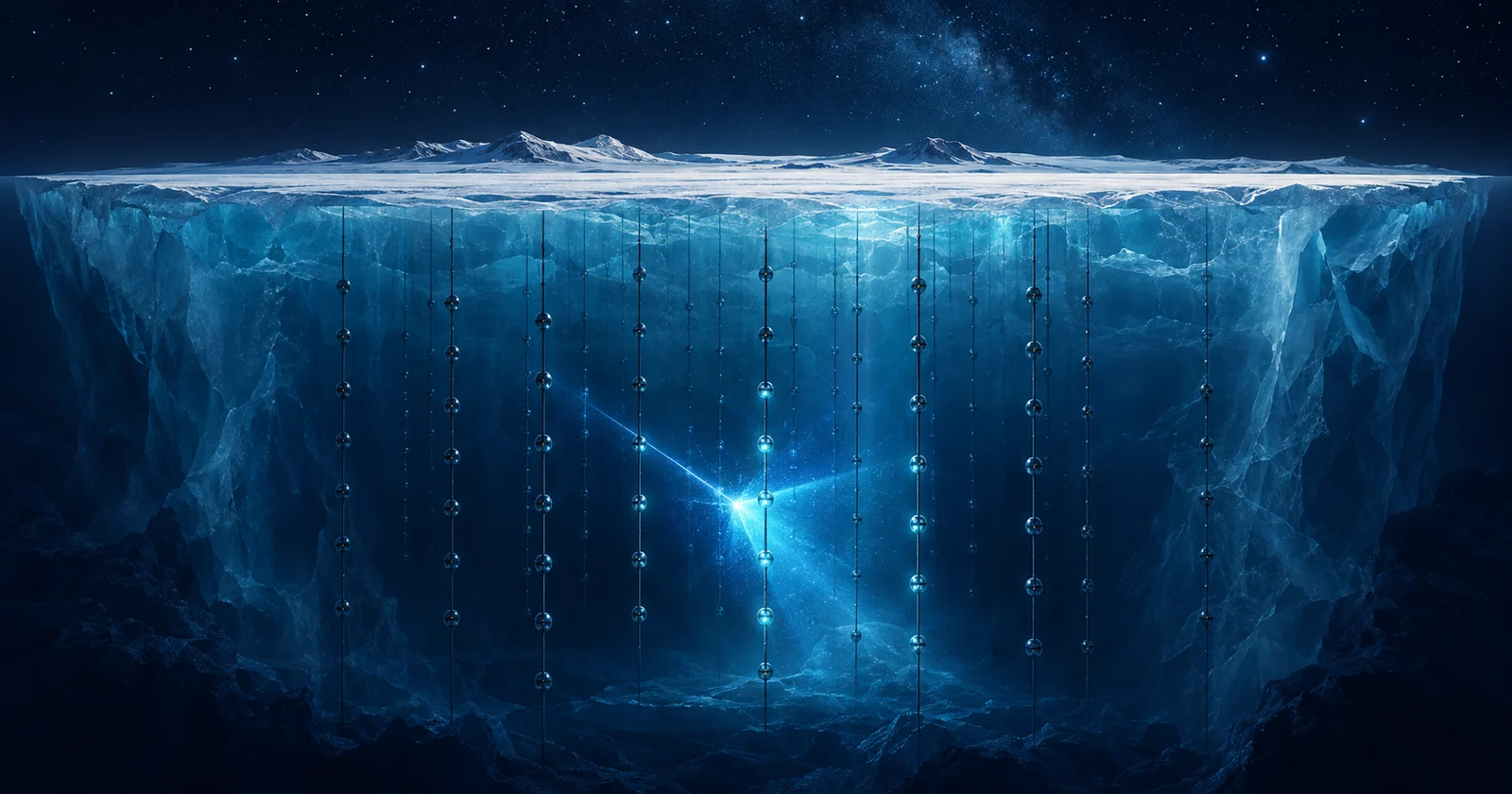
IceCube’s detector has to be enormous because neutrinos are so hard to catch. These electrically neutral particles rarely interact with matter, and magnetic fields do not bend their paths through space. That makes them useful messengers from distant objects. Halzen helped turn this approach into an observatory built and operated by an international collaboration at the South Pole.
What the ice is doing
The ice itself is part of the instrument. When a neutrino interacts with it, the collision can create charged particles that give off a faint glow called Cherenkov light. Thousands of sensors record those flashes across a cubic kilometre. Researchers use the timing, brightness and pattern to estimate the neutrino’s direction and energy.
Installing them meant melting deep holes with hot water, then lowering cables of sensors before the holes froze again.
The challenge is telling neutrinos from distant objects apart from particles produced in Earth’s atmosphere. In a 2013 study, IceCube reported 28 high-energy events in data collected between May 2010 and May 2012, more than expected from atmospheric backgrounds. Taken together, the events’ numbers, energies and directions provided evidence for an additional population arriving from space.
A clue from a distant galaxy
On 22 September 2017, IceCube detected a high-energy neutrino and alerted other observatories. Results published in 2018 pointed to the blazar TXS 0506+056, a distant galaxy whose central black hole powers a jet aimed roughly towards Earth, as a likely source. Gamma-ray observations and a separate search of archived IceCube data strengthened the case.
What this lets us learn
Cosmic rays are energetic charged particles. Magnetic fields bend their paths, making their birthplaces hard to trace. Neutrinos can also carry information out of regions that block gamma rays. Measuring neutrinos alongside light gives scientists another way to investigate cosmic particle accelerators.
That adds a test that light alone cannot provide. Gamma rays can come from energetic electrons or from interactions involving protons. High-energy neutrinos add evidence for the proton interactions. Combining both signals helps researchers distinguish competing explanations of how a distant source works.
In its 2023 Milky Way study, the collaboration used machine learning to improve the identification of neutrino events and estimates of their direction and energy. The team applied these methods to ten years of observations, finding evidence of high-energy neutrino emission from our galaxy.
We also cover how AI supports laboratory research in AI in Chemistry, and the companies working on neural interfaces and diagnostics in The State of NeuroTech 2026.
Three places to go deeper
- The Nobel Committee’s illustrated explainer — Start here for the physics, the choice of Antarctic ice and the history behind the prize.
- IceCube’s account of the 2018 discovery — Follow the observations that connected a neutrino alert with a distant galaxy, with diagrams of the detector and the source.
- The Milky Way through a neutrino lens — A visual introduction to the 2023 result, including an explanation of how machine learning helped the analysis.

DRL Team ↗
AI R&D Center
Our team shares experiences and insights on how AI and ML change and shape new markets, optimize various industries and our lives.