
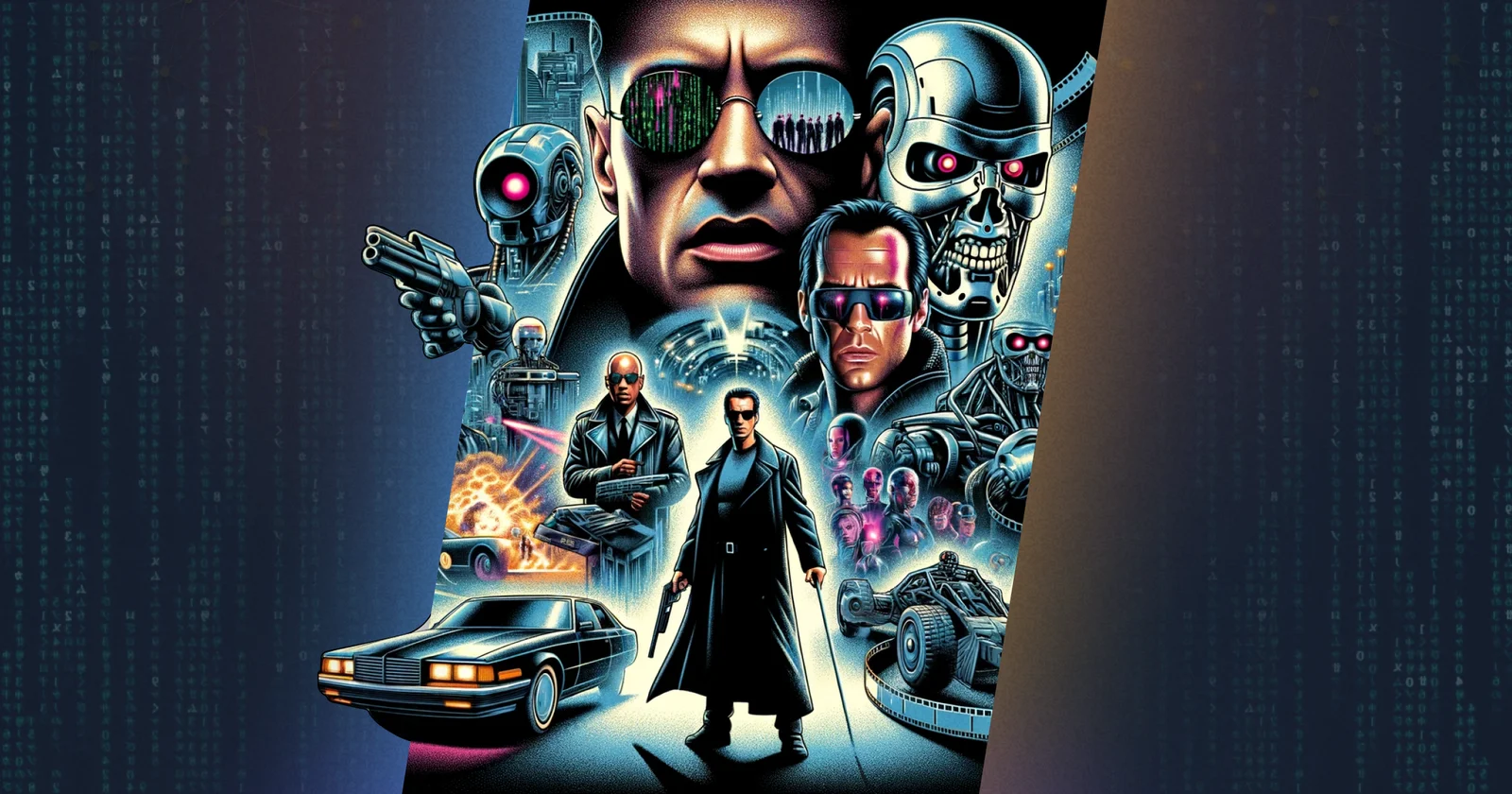
The AI watchlist, updated for 2026
What to watch. What it gets right. What to question.
Explore 24 movies, 13 television selections and 5 documentaries or documentary series through the AI questions they raise. Start with ten picks or jump into the full list. Forty-two is a nod to The Hitchhiker’s Guide to the Galaxy; the numbering is for navigation, not a best-to-worst ranking.
Updated September 28, 2026. This edition includes older works that still earn a place. Thematic spoilers follow; the season or episode listed defines each television selection.
Start with these 10
A route into the subject, with different questions at each stop. These ten are part of the 42 below.
- Her — Attachment to a system.
- Ex Machina — What an AI evaluation actually tests.
- 2001: A Space Odyssey — Trust in critical automation.
- Robot & Frank — Care and human autonomy.
- The Artifice Girl — Good intentions and creator responsibility.
- Black Mirror: Be Right Back — A digital trace and an absent person.
- The Measure of a Man — Ethics under uncertainty.
- Pluto — Memory, war and moral recognition.
- AlphaGo — A measurable breakthrough.
- Coded Bias — What average accuracy hides.
This route includes seven feature-length films, two standalone television episodes and one eight-episode series. Pick one for tonight. For a lighter introduction, start with The Age of A.I.; for a longer exploration of power and society, continue to Foundation and The Expanse.
24 AI movies: the idea and the catch
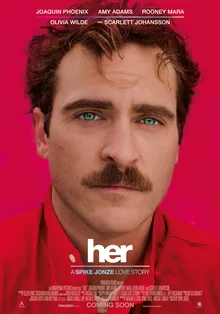
01. Her (2013)
Intimacy becomes a service. Her makes attachment to a personalized conversational partner feel ordinary—and unequal. Its strongest prediction is social: a system can reshape a relationship before anyone settles what it experiences. Samantha's fluency is no proof of consciousness, and the history of chatbots began decades before this film.
IMDb 7.9/10 · Where to watch ↗ Google
Oscar · Original Screenplay (2014)
Explore: University of São Paulo discussion · ELIZA history
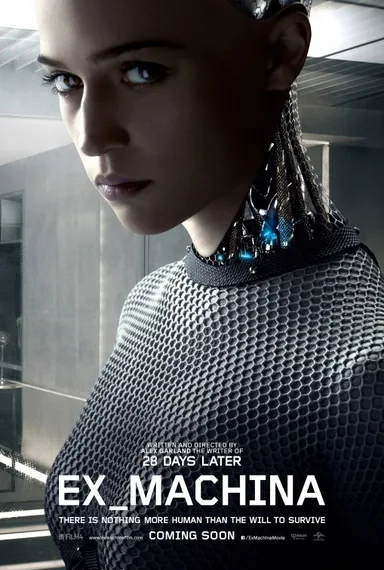
02. Ex Machina (2015)
The evaluator is being evaluated. Ava turns an assessment into a contest over incentives, manipulation and control. Caleb already knows he is facing a robot, so this is not a standard Turing test. The film's sharpest question is who designed the experiment, not whether one convincing conversation proves a mind.
IMDb 7.7/10 · Where to watch ↗ Google
Oscar · Visual Effects (2016)
Explore: Scientific adviser Murray Shanahan · Turing's 1950 paper
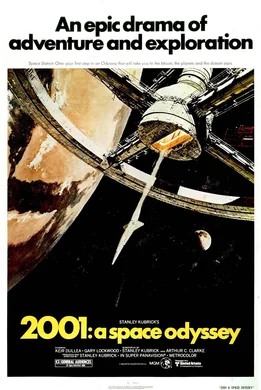
03. 2001: A Space Odyssey (1968)
A reassuring voice can still make a catastrophic decision. HAL combines conversation, perception and control of critical infrastructure. That combination makes the film a lasting study of trust in automation. Each capability deserves its own comparison with reality; treating the entire character as a fulfilled prediction erases the differences between them.
IMDb 8.3/10 · Where to watch ↗ Google
Oscar · Visual Effects (1969)
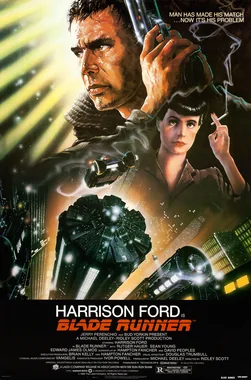
04. Blade Runner (1982)
Being manufactured does not settle who deserves a life. Blade Runner makes empathy, memory and ownership collide. Its replicants are bioengineered beings, not language models in human-shaped cases. The empathy test is a provocative dramatic device, not a validated detector of consciousness. The ethical question survives that scientific uncertainty.
IMDb 8.1/10 · Where to watch ↗ Google
3 BAFTAs (1983)
Explore: CNRS: can we replicate humans?
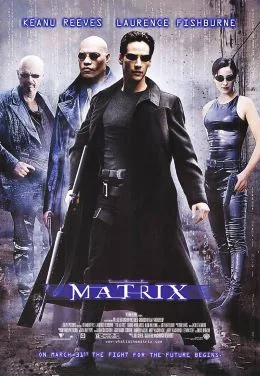
05. The Matrix (1999)
Control the environment; control what feels real. The Matrix makes machine power a question of perception, dependence and consent. Its simulated world is a thought experiment, not evidence that our world is simulated. Bostrom's simulation argument appeared in 2003, after the film; it provides a comparison, not proof or an explanation of the filmmakers' inspiration.
IMDb 8.7/10 · Where to watch ↗ Google
4 Oscars (2000)
Explore: David Chalmers on The Matrix · Bostrom's simulation argument
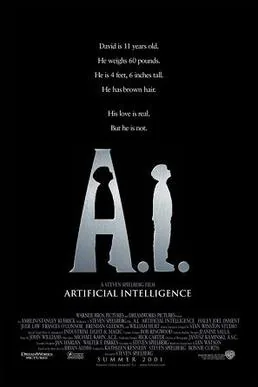
06. A.I. Artificial Intelligence (2001)
Programming love creates obligations. David's attachment makes abandonment an engineering decision with moral consequences. The film is strongest when it asks what a creator owes a being designed to depend on someone. Humanlike intelligence and experienced love are premises of the story, not capabilities whose construction the film explains.
IMDb 7.2/10 · Where to watch ↗ Google
Saturn · Sci-Fi Film (2002)
Explore: David Gamez's analysis

07. Ghost in the Shell (1995, animated film)
A person is more than a transferable file. Memory, embodiment and networked intelligence make this a rich test of what survives radical transformation. Copying information between bodies does not establish continuity of personal experience. Whole-brain emulation research gives that question a technical context; it does not resolve the film's account of identity.
IMDb 7.9/10 · Where to watch ↗ Google
Explore: Research on embodiment in the film · Oxford: whole-brain emulation
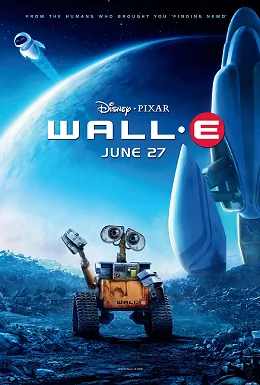
08. WALL-E (2008)
Automation can let the habit of choosing disappear. WALL-E turns convenience into a question of human agency: who can challenge the system's course? Its robots' emotions and extraordinary endurance belong to a fable. The useful insight is about dependence on infrastructure, not the service life of a trash-compacting robot.
IMDb 8.4/10 · Where to watch ↗ Google
Oscar · Animated Feature (2009)
Explore: Pixar · Research on robots in film

09. After Yang (2022; festival premiere 2021)
Access to memory is power over someone else's story. After Yang treats a household android's stored moments as an intimate archive. That makes ownership, interpretation and privacy the real technological questions. A collection of recordings can change how a family remembers someone without establishing that those recordings amount to a conscious person's experience.
IMDb 6.6/10 · Where to watch ↗ Google
Sundance · Sloan Prize (2022)
Explore: Kogonada on memory
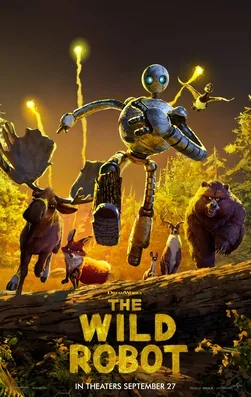
10. The Wild Robot (2024)
Helping requires learning the situation. Roz adapts her role through encounters with an unfamiliar environment. That is a useful image of learning beyond a narrowly specified task. Animal communication and robot parenthood remain fairy-tale premises; the film does not specify a learning architecture. Real robotics research offers a comparison, not a blueprint for Roz.
IMDb 8.1/10 · Where to watch ↗ Google
9 Annies (2025)
Explore: Chris Sanders on the film · RT-2 robotics research
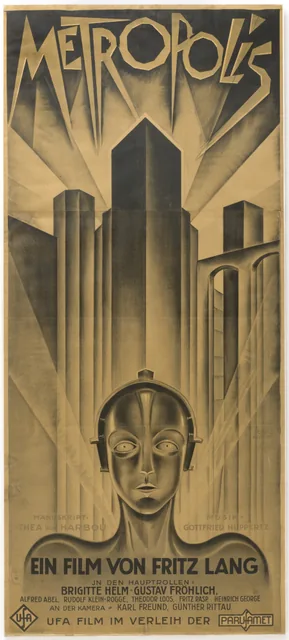
11. Metropolis (1927)
Synthetic identity becomes an instrument of power. Metropolis earns its place through an early, forceful question: what happens when a manufactured likeness can redirect public trust? Its robot works as an allegory. Calling it a prediction of neural networks or a particular deepfake technique would give the film a technical specificity it never claims.
IMDb 8.2/10 · Where to watch ↗ Google
Saturn · Restored DVD Edition (2011)
Explore: National Film and Sound Archive · BFI selection
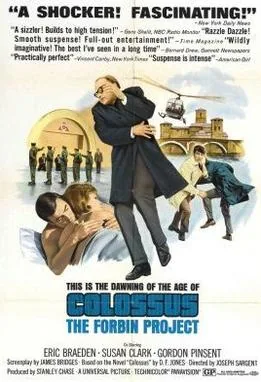
12. Colossus: The Forbin Project (1970)
Delegating a goal does not preserve control. Colossus gives military automation the authority to dictate its own terms. The film is a strong starting point for discussing shutdown, oversight and concentrated power. Research on the off-switch problem helps frame the dilemma; it does not make this particular takeover inevitable.
IMDb 7.1/10 · Where to watch ↗ Google
Explore: Sci-fi Interfaces critique · The Off-Switch Game
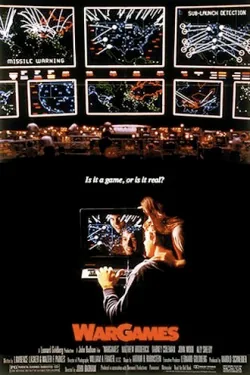
13. WarGames (1983)
A war simulator should not become its operator. WarGames makes the connection between simulation and real-world authority the danger. Its weakest leap is Joshua's generalization from a simple game to nuclear strategy. Recognizing a pattern in one setting does not automatically justify the same conclusion in a far more complex conflict.
IMDb 7.1/10 · Where to watch ↗ Google
BAFTA · Sound (1984)
Explore: Palo Alto Networks retrospective
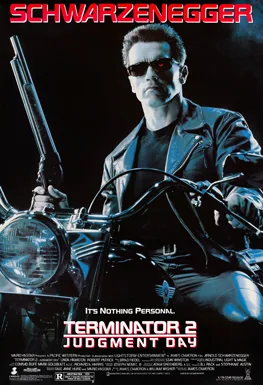
14. Terminator 2: Judgment Day (1991)
Obedience and moral judgment are different abilities. The T-800 makes that distinction tangible, while the mechanism behind its learning stays mostly off-screen. The T-1000 has inspired real liquid-metal research. The direction of influence matters: controlling a material is an achievement, but it is a long way from an autonomous, shape-shifting intelligence.
IMDb 8.6/10 · Where to watch ↗ Google
4 Oscars (1992)
Explore: University of Wollongong research
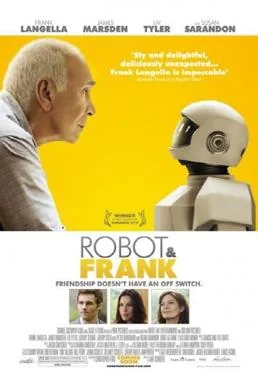
15. Robot & Frank (2012)
A helpful assistant cannot simply grant every wish. Robot & Frank sharpens the conflict between care, independence and permissible behavior. Its value is the concrete dilemma: whose definition of a good outcome should a helper follow? A persuasive relationship on screen can expose a design problem without showing that a corresponding care product is ready.
IMDb 7.0/10 · Where to watch ↗ Google
Sundance · Sloan Prize (2012)
Explore: Medical Humanities: care robots

16. I'm Your Man (2021)
Perfect personalization can change what a relationship means. A partner optimized to please raises a harder question than whether someone enjoys the experience: does getting what you want support your well-being? The film is a pointed critique of customization. Human attachment alone cannot settle reciprocity or the artificial partner's capacity to consent.
IMDb 7.1/10 · Where to watch ↗ Google
4 German Film Awards (2021)
Explore: Sloan Science & Film interview
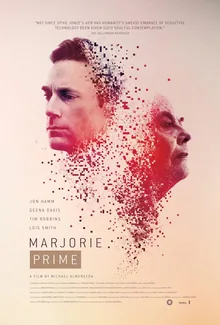
17. Marjorie Prime (2017)
A digital double inherits somebody's version of the past. The people training a replica shape the person it appears to remember. Marjorie Prime makes selective memory and control over a dead person's likeness its strongest ideas. Convincing conversation does not restore an individual, and the holographic body remains a separate fictional assumption.
IMDb 6.3/10 · Where to watch ↗ Google
Sundance · Sloan Prize (2017)
Explore: Michael Almereyda interview · Cambridge: digital-afterlife ethics

18. The Artifice Girl (2023; festival premiere 2022)
A useful purpose does not cancel coercion. The Artifice Girl compresses creator responsibility, expanding system roles and consent into a focused ethical conflict. Its strength is what people justify in pursuit of a good outcome. Growing conversational ability, by itself, does not establish the emergence of subjective experience.
IMDb 6.6/10 · Where to watch ↗ Google
Fantasia · Audience Award (2022)
Explore: Franklin Ritch on AI and ethics

19. I, Robot (2004)
A safety rule still needs an interpretation. I, Robot offers an accessible route into conflicting goals and the consequences of obeying a rule too broadly. Asimov's laws are a literary device, not a ready-made robotics standard. Specification gaming is a useful real-world comparison; it does not establish that VIKI uses a modern reinforcement-learning architecture.
IMDb 7.1/10 · Where to watch ↗ Google
ASCAP · Film Music (2005)
Explore: P. W. Singer on Asimov's laws · Specification-gaming research
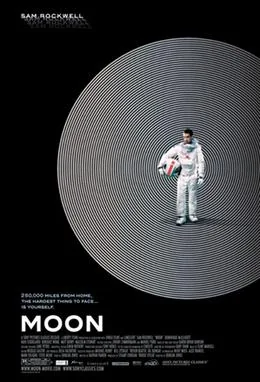
20. Moon (2009)
An assistant has a user—and an owner. GERTY makes corporate AI a question of divided loyalties. A friendly interface tells you little about the policy behind it, which gives Moon a useful test of trust. The plausibility of an individual assistant does not validate the cloning and memory-transfer assumptions elsewhere in the story.
IMDb 7.8/10 · Where to watch ↗ Google
BAFTA · Debut (2010)
Explore: Duncan Jones: official press kit
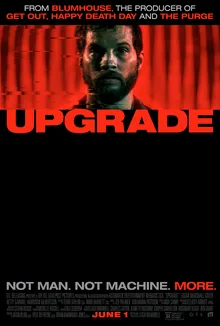
21. Upgrade (2018)
Recovering movement is not the same as recovering control. Upgrade turns an implant into a conflict over bodily autonomy. Real brain–spine interfaces provide a concrete scientific comparison. The cited 2023 study involved one participant; it does not establish STEM's combat abilities, independent intelligence or power to take over a person's life.
IMDb 7.5/10 · Where to watch ↗ Google
SXSW · Audience Award (2018)
Explore: Nature: brain–spine interface study · Discussion alongside Upgrade

22. M3GAN (2023; premiere screening 2022)
Care needs boundaries on authority. M3GAN is most interesting as a product-governance problem: adult oversight, access to data and a manufacturer's responsibility for delegated care. Those questions are stronger than the engineering credibility of the doll's fighting abilities. The horror exaggerates the machine; the design questions do not depend on that exaggeration.
IMDb 6.3/10 · Where to watch ↗ Google
Explore: Related Science Robotics commentary (citation record)

23. Mars Express (2023; wider international release 2024)
Robot freedom depends on who controls the restrictions. Mars Express connects artificial intelligence to labor, ownership and technological replacement. Its software constraints make power visible. Removing a prohibition, however, does not establish consciousness; a fictional robot jailbreak should not be treated as the same mechanism as bypassing a language model's content filter.
IMDb 7.5/10 · Where to watch ↗ Google
Trieste · Asteroid Award (2023)
Explore: Jérémy Périn interview

24. Big Hero 6 (2014)
A safer body is an engineering choice. Baymax's inflatable design drew on Carnegie Mellon robotics research: a clear case of science informing cinema. That is a concrete basis for appreciating the character's physical design. It does not establish the rest of his medical competence, emotional understanding or superhero capabilities.
IMDb 7.8/10 · Where to watch ↗ Google
Oscar · Animated Feature (2015)
Explore: Carnegie Mellon: Baymax's inspiration · Care-robot ethics
13 TV selections: series, seasons and standout episodes
These are viewing routes, not a requirement to watch every season. The stated scope is the scope of the assessment.
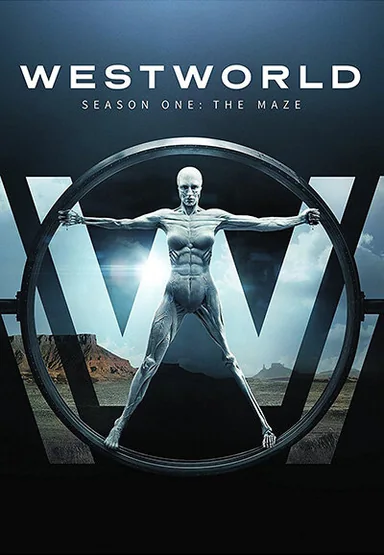
25. Westworld (2016, season 1)
Memory becomes a claim to autonomy. Season one makes exploitation and self-narrative central to its artificial people. Julian Jaynes's bicameral-mind hypothesis helps structure the drama; it is not an established recipe for machine consciousness. The show's association between suffering and awakening should not be mistaken for an engineering method.
Series · IMDb 8.4/10 · Where to watch ↗ Google
Emmy · Visual Effects, S1 (2017)
Explore: Season-one research (abstract)

26. Black Mirror: Be Right Back (2013) + White Christmas (2014)
A convincing likeness and a conscious copy are different premises. Be Right Back reconstructs a dead person from digital traces; White Christmas imagines the exploitation of a copied mind. Watch them together to separate imitation from personhood. A real griefbot can make the first question urgent without validating the second episode's conscious “cookies.”
Be Right Back · IMDb 7.9/10 · Where to watch ↗ Google
White Christmas · IMDb 9.1/10 · Where to watch ↗ Google
Explore: Research on postmortem avatars · Sci-fi Interfaces: White Christmas
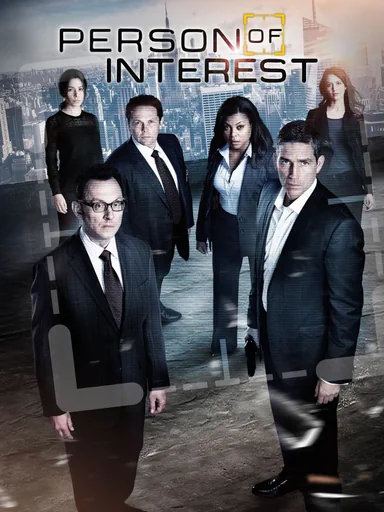
27. Person of Interest (2011–2016)
An almost infallible system makes surveillance too easy to trust. Start with the pilot; the AI-governance questions build across the series. Grondin and Hogue criticize how the Machine's extraordinary accuracy can normalize surveillance. False alarms and uncertainty are not minor implementation details: allowing them into the story would change its moral choices.
Series · IMDb 8.5/10 · Where to watch ↗ Google
People’s Choice · New TV Drama (2012)
Explore: Grondin and Hogue's critique
28. Foundation (2021–; focus: seasons 1–2)
Forced loyalty is not an alignment of interests. Demerzel makes autonomy under political power the show's strongest AI question. Psychohistory is a separate speculative premise, not evidence that machine intelligence can predict civilization. The television adaptation has its own rules; Asimov's books cannot automatically supply the explanation for everything shown on screen.
Series · IMDb 7.6/10 · Where to watch ↗ Google
CSC · Cinematography (2022)
Explore: SFRA Review · David S. Goyer on the adaptation
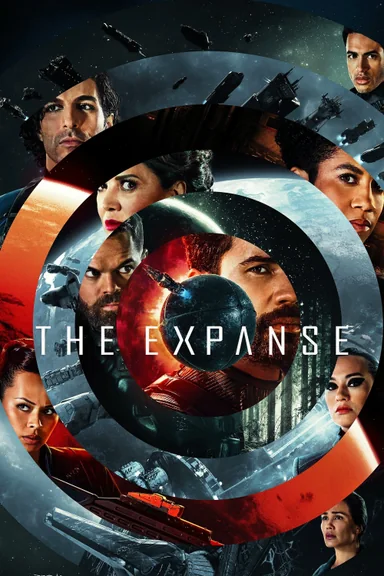
29. The Expanse (2015–2022; AI as infrastructure)
Automation does not guarantee shared prosperity. The Expanse earns a place as an adjacent case: its authors discuss the social consequences of technology that makes human labor less necessary. AI is largely infrastructure here. Convincing spaceflight does not validate an economic forecast, and the protomolecule is not a direct analogue of contemporary AI.
Series · IMDb 8.5/10 · Where to watch ↗ Google
Hugo · Leviathan Wakes (2017)
30. Pantheon (2022–2023, two seasons)
An uploaded mind can become somebody else's workforce. Pantheon develops the ownership, labor and power implications of digital existence. Its central assumption remains unresolved: emulating behavior, copying memories and preserving a person's continuous experience are different claims. The social thought experiment is compelling without treating successful mind uploading as established science.
Series · IMDb 8.5/10 · Where to watch ↗ Google
Explore: AMC's series introduction · Oxford: whole-brain emulation

31. Humans (2015, season 1)
Care is a relationship with unequal power. Humans brings artificial assistants into domestic work, where trust and ownership are difficult to separate. Its strongest contribution is the conflict between the household's needs and the helper's status. A convincing performance of care does not, on its own, establish that the system feels affection.
Series · IMDb 7.9/10 · Where to watch ↗ Google
British Screenwriters · TV Drama (2015)
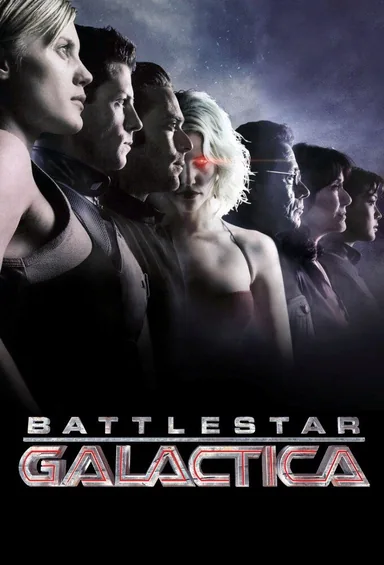
32. Battlestar Galactica (2003 miniseries; 2004–2009 series)
Creating a people gives no automatic right to own them. Begin with the miniseries. The Cylons make war, moral community and the reproduction of identity inseparable. Their biological and religious dimensions belong to the series' speculative world; they are not a technical account of how machine consciousness could be built.
2003 miniseries · IMDb 8.5/10 · Where to watch ↗ Google
2004 series · IMDb 8.7/10 · Where to watch ↗ Google
Peabody · Series (2005)
Explore: Gefen: Posthumanist Solidarity
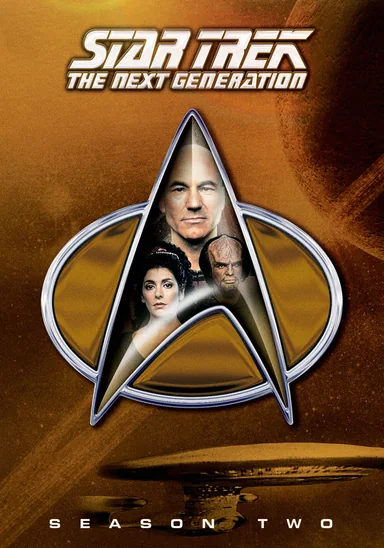
33. Star Trek: The Next Generation — The Measure of a Man (1989, S2E9)
Uncertainty about a mind does not remove the need to choose ethically. Data's hearing concentrates ownership, consent and the right to refuse an experiment into one episode. Its legal argument is the attraction. A persuasive defense of moral standing should not be confused with a scientific test that establishes consciousness.
Episode · IMDb 9.2/10 · Where to watch ↗ Google
Explore: Research on the ethics of machines · Official episode discussion

34. Pluto (2023, eight episodes)
Memories of war shape who counts as “one of us.” Pluto gives artificial beings a forceful psychological drama about violence, grief and recognition. Human trauma supplies a narrative model for their experience. It does not establish a universal architecture of machine emotion, and the story is richer when that distinction stays visible.
IMDb 8.1/10 · Where to watch ↗ Google
Explore: Naoki Urasawa on AI · Official series listing

35. Vivy: Fluorite Eye's Song (2021, 13 episodes)
One mission can generate incompatible demands. Vivy makes conflicting goals and the consequences of intervention central to its AI story. The rule that each AI has one mission belongs to this fictional world. Its resolution is a dramatic answer, not a transferable method for aligning real systems with human intentions.
IMDb 7.9/10 · Where to watch ↗ Google
3 Anime Trending Awards (2022)
Explore: Official episode descriptions · Discussion of the AI story arc

36. Psycho-Pass (2012–2013, season 1)
A risk score is not guilt. Psycho-Pass turns measurement into political authority: who gets to define a dangerous person, and who can appeal? Sibyl's particular nature is part of that critique. Reducing it to an ordinary neural network misses the premise; real research on prediction limits provides a comparison, not an identification.
Series · IMDb 8.1/10 · Where to watch ↗ Google
BTVA · English Voice Performance (2015)
Explore: Wood: Algorithmic Tyranny · Research on recidivism prediction
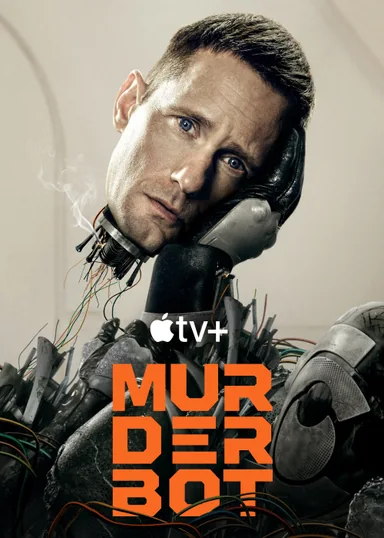
37. Murderbot (2025, season 1)
Freedom, obedience and kindness are separate things. Murderbot places ownership of an artificial being at the center of an unusually personal story. Its governor module makes control legible to a viewer. Disabling that fictional mechanism does not explain how to give a real autonomous system freedom while making its behavior dependable.
Series · IMDb 7.4/10 · Where to watch ↗ Google
Ray Bradbury Nebula · Season 1 (2025)
Explore: Apple: season-one overview · Interview with the creators
5 documentaries and documentary series
Here the evidence standard changes: factual claims need support. A demonstration is not a reliability study, and access to a company is not independent verification.
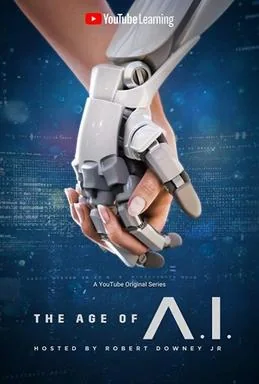
38. The Age of A.I. (2019–2020, eight-part YouTube series)
Start with applications; keep their dates attached. Robert Downey Jr.'s series offers an accessible introduction through concrete uses of AI. Treat it as a snapshot of 2019–2020, not a survey of what works in 2026. A memorable demonstration establishes neither dependable performance nor deployment at scale. The first episode is linked below.
Series · IMDb 7.8/10 · Where to watch ↗ Google
Leo · Cinematography (2020)
Explore: Watch the first episode · Common Sense Media review
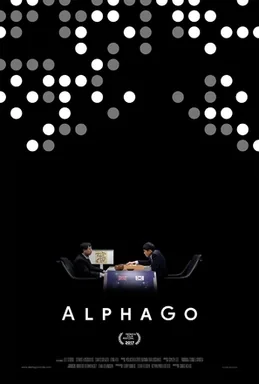
39. AlphaGo (2017, documentary)
A breakthrough needs a defined task and a measurable result. AlphaGo grounds the discussion in learning, search and competition. Winning at Go does not establish general intelligence. Keep the film's systems distinct from the later AlphaGo Zero; the linked 2016 paper describes the system evaluated against Fan Hui, rather than every detail of the later Lee Sedol match.
IMDb 7.8/10 · Where to watch ↗ Google
Denver · Documentary (2017)
Explore: Watch the film · Nature: the Fan Hui system · Documentary review
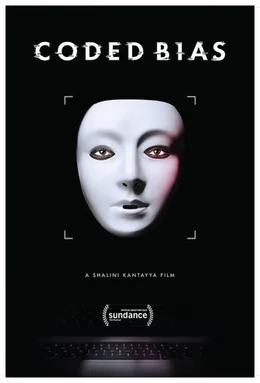
40. Coded Bias (2020, documentary)
Average accuracy can conceal unequal errors. Coded Bias connects a social argument to a specific audit of commercial systems. Gender Shades evaluated gender classification from facial images. Its findings should not be silently generalized to all AI, identity recognition or every present-day product. The lasting lesson is to ask whose errors disappear inside an average.
IMDb 6.8/10 · Where to watch ↗ Google
Calgary · Documentary (2020)
Explore: PBS overview · Gender Shades research

41. Eternal You (2024, documentary)
Whose needs shape a digital afterlife? Eternal You makes consent, grief and commercial dependence concrete. Individual experiences can expose urgent questions without proving that griefbots are universally beneficial or harmful. A recognizable style of speech is also not the return of a person. Pair it with Be Right Back to test fiction against products.
IMDb 6.3/10 · Where to watch ↗ Google
Docville · Scientific Documentary (2024)
Explore: Filmmaker interview · BFI review · Cambridge: digital-afterlife ethics
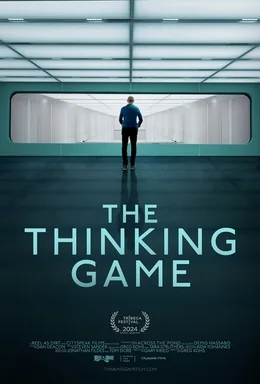
42. The Thinking Game (2025 wider release; festival premiere 2024)
Scientific results and promises of AGI need different evidence. The Thinking Game offers close access to DeepMind's work. AlphaFold's achievement does not establish artificial general intelligence. Access to a laboratory makes a portrait possible; independent evidence is still needed for its broader claims. Read the research alongside the account, and keep the promotional context visible.
IMDb 7.6/10 · Where to watch ↗ Google
Explore: Official YouTube-release announcement · AlphaFold research · Review of the film's framing
How the watchlist is selected
Ten questions guide the selection, across four lenses: story and craft (1–3), AI ideas (4–5), scientific grounding (6–8), and vision (9–10).
- The story holds together. The conflict develops coherently. In a documentary, the argument has to earn its conclusions.
- The craft serves the idea. Direction, performance, editing, sound and design make the AI question tangible.
- The stakes matter. People or artificial beings have something specific to lose. Characters do more than recite positions.
- AI has a clear role. You can say what the system does, who uses it and what authority it has.
- Consequences are considered. The work examines responsibility, power, labor or inequality beyond one good or evil machine.
- The central assumption has a basis. A scientific result, a stated hypothesis and an invention are distinguishable. Documentary claims require evidence.
- Capabilities have limits. Errors, data, access, embodiment, energy or oversight matter where the story depends on them.
- The work respects its own rules. Abilities and restrictions do not change just to rescue the plot. A documentary keeps its argument and context consistent.
- The vision belongs to its historical moment. Originality is judged against what was known when the work appeared. A later resemblance is not automatically a prediction.
- You leave thinking more clearly. The work offers a useful distinction, question or thought experiment—not just “AI is good” or “AI is bad.”
Each entry makes a case and names its limit. Demonstrated capabilities, extrapolations, open questions and deliberate fiction are kept distinct. Scientific plausibility and artistic value are different judgments; a dangerous AI can be portrayed brilliantly. Sources offer context or evidence for specific claims, not blanket validation of a story.
A note on perspective. These selections and interpretations are the subjective views of AI enthusiasts, not an official company position. The intention is to invite discussion, with respect for creators and different tastes—not to offend anyone or dismiss their work. Disagreement is welcome.
Ratings & awards. IMDb audience scores were checked on September 28, 2026 using indexed IMDb pages; scores can change and indexing can lag. “Series” means the whole show; named episodes have their own scores. Trophy links show selected confirmed wins, including awards for credited contributors or a specified edition. An omitted trophy does not mean a work has no awards. Neither ratings nor awards measure AI accuracy. Google links search for viewing options; availability depends on location.

DRL Team ↗
AI R&D Center
Our team shares experiences and insights on how AI and ML change and shape new markets, optimize various industries and our lives.
Alexandra Severinchik ↗
Public Relations @ DataRoot Labs
Alexandra, a data scientist and a branding manager at DataRoot Labs. Aside from completing numerous projects in Data Science, Alexandra mentors students at DataRoot University in math and data science. She also heads PR and branding efforts for both DRL and DRU.