
Reliable mobile data synchronization for field teams with unreliable connectivity
Project scope
This case covers one part of an anonymized mobile operations platform. The five cases in this series describe the same engagement. DataRoot Labs worked through a product-development partner and directly with the end client’s management.
Bounding the upload work
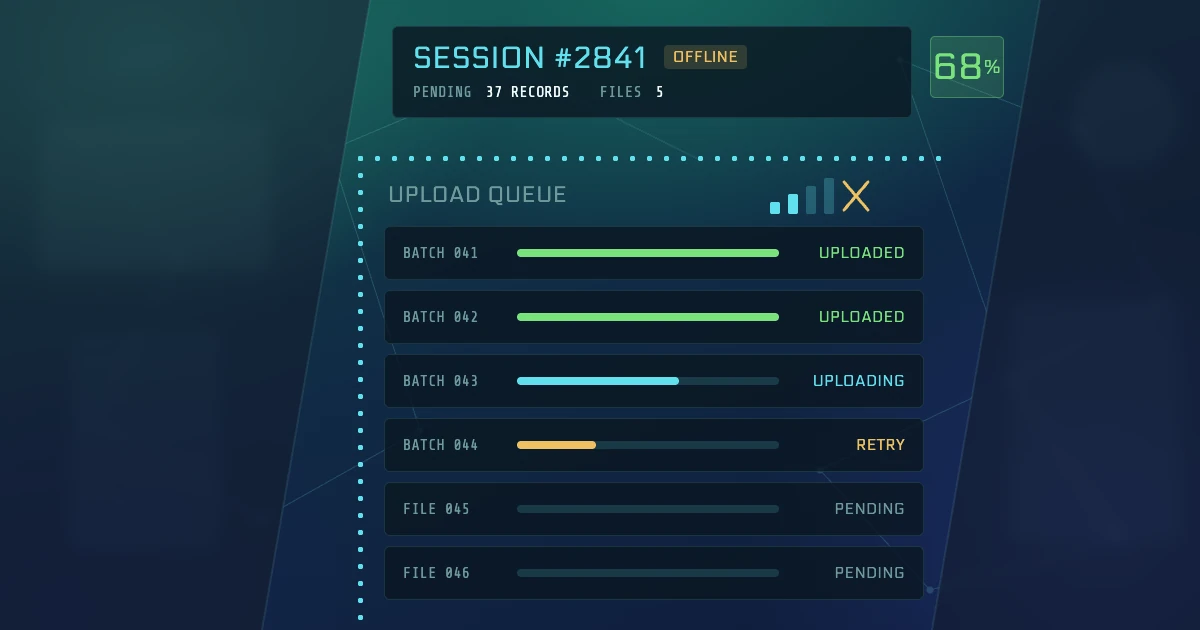
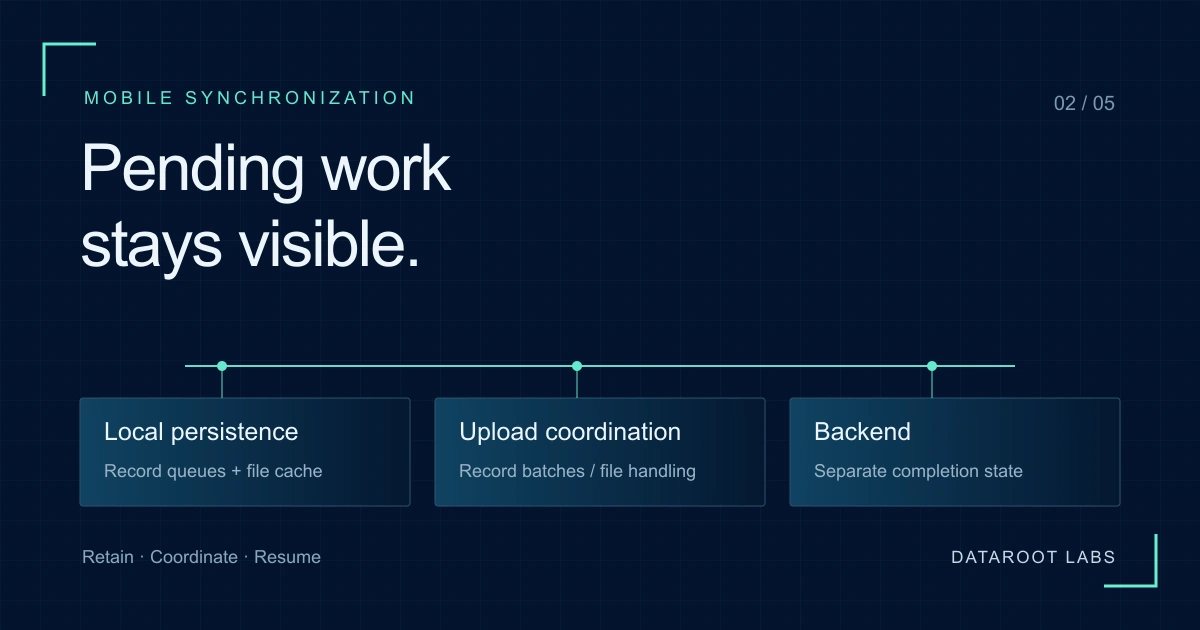
Pending records enter persistent local queues. A shared uploader takes batches from those queues and advances them after successful delivery. Retryable failures retain work for a later attempt; cached audio and other files have separate upload handling alongside the structured records.
A row-count limit alone is insufficient when record sizes vary. The uploader also checks serialized byte size, keeping a batch within its payload budget without assuming that every sensor record has the same shape.
Several triggers, coordinated uploads
Returning to the foreground, a background task, a manual synchronization action, session transitions and a foreground interval can all request an upload. The implementation coordinates in-flight work so these triggers do not independently drain the same queue.
Each trigger is an opportunity to make progress. The application still depends on connectivity and operating-system execution time; background scheduling cannot promise an exact upload time. Progress and unsynchronized-state tracking let the interface explain which work remains.
When is a session complete?
The session-ending event can reach the backend before the backlog is drained. The product tracks upload completion separately from that session transition. Review workflows can use those distinct states instead of treating the end of the user’s session as proof that every upload succeeded.
This design supports recoverable delivery under intermittent connectivity. It does not by itself establish exactly-once delivery or a no-data-loss guarantee. Those claims would require additional evidence about storage, server behavior and failure testing.
Where this applies
This approach fits inspection, maintenance, survey, and other field-data platforms that collect records and files outside dependable network coverage. Adapting it requires customer-specific data models, storage limits, payload sizes, backend APIs, and completion rules. Upload completion rates, backlog recovery time, and support effort would be useful measures of business benefit; no numerical improvement is claimed here.
Published