
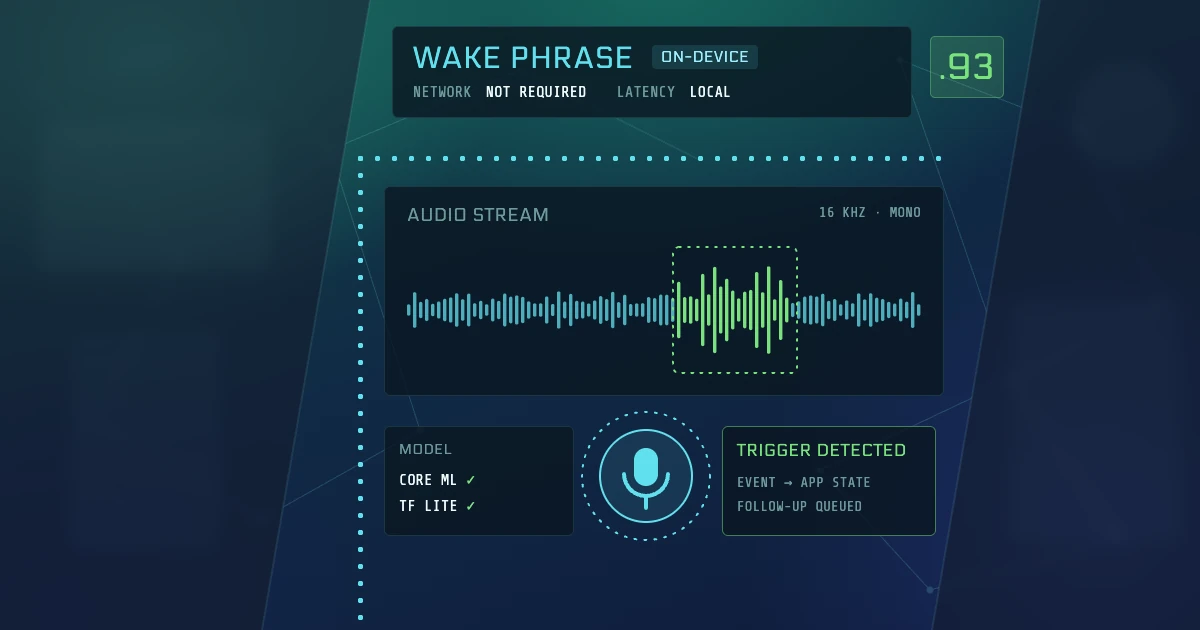
Custom on-device voice activation for iOS and Android apps
Project scope
This case covers one part of an anonymized mobile operations platform. The five cases in this series describe the same engagement. DataRoot Labs worked through a product-development partner and directly with the end client’s management.
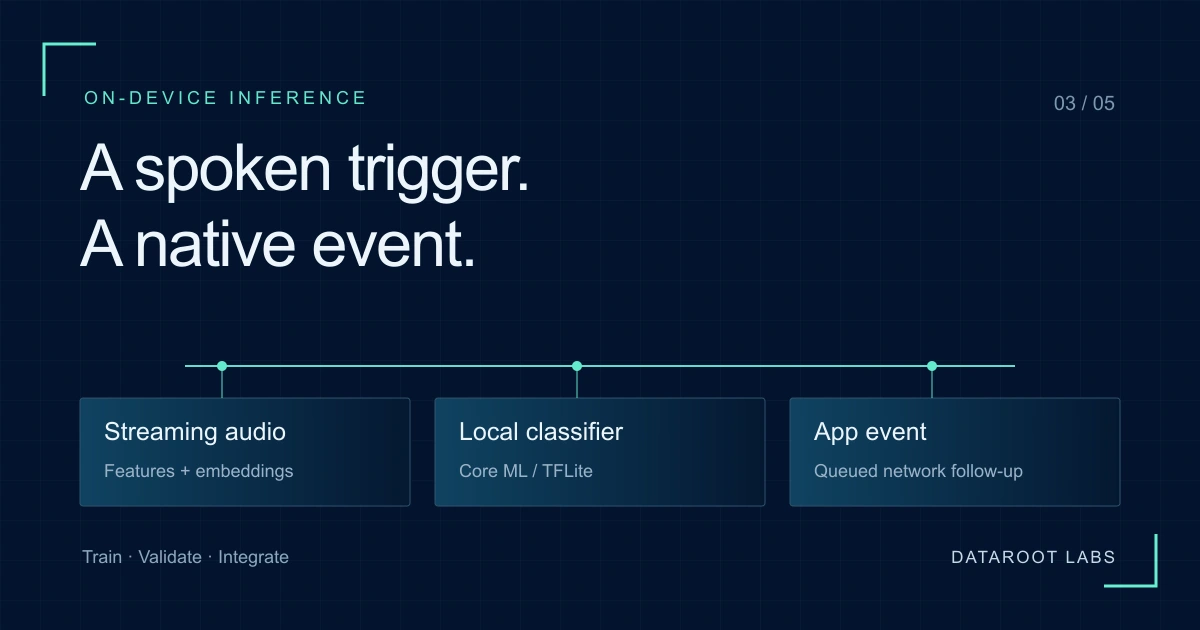
From audio to a trigger
The model-development workflow uses Python and openWakeWord, with data generation and augmentation for a custom activation phrase. The inference chain passes audio through feature extraction, speech embeddings and a classifier. Streaming buffers retain the context needed as audio arrives in chunks.
The activation phrase and the downstream operational action remain confidential. The technical focus is the path from audio input to an event that the mobile application can manage.
Porting the streaming path
The reference workflow uses ONNX. The iOS engine runs with Core ML in Swift; Android uses TensorFlow Lite in Java. A Capacitor plugin presents a common event interface to the shared application.
The project’s validation workflow compares native-engine behavior on test audio with the Python reference, including startup, reset and repeated input. Negative audio and longer-running samples add checks within the validation set. These tests examine whether the native implementation behaves as expected; they are distinct from measuring recognition accuracy across real users, devices and acoustic conditions.
Connecting detection to the product
The application handles detections as managed events, coordinating them with visible user state rather than letting each detection start an overlapping workflow. If a server-side follow-up cannot be delivered, it is queued for another attempt. A lost connection therefore affects delivery independently of local recognition.
Deployment on another product would require evaluation of its phrase, representative audio, target devices, permissions and battery use. This case describes the subsystem’s integration, without claiming a measured latency, recognition rate or safety-critical qualification.
Where this applies
Potential applications include inspection and maintenance products whose users need a voice shortcut during field tasks, and software vendors adding custom wake-word recognition to an existing app. Each deployment would need its own phrase, representative audio, device evaluation, permission handling, and battery testing. The validation described here does not establish field recognition accuracy or suitability for safety-critical use.
Published